



Institutional Resource Management System
The Institutional Resource Management System (iRMS) is an NEP 2020–compliant Enterprise Resource Planning (ERP) system for colleges, designed to streamline and integrate various administrative and academic processes. It covers modules such as student information, admissions, finance, human resources, course management, and more — providing a unified platform to manage all college operations.
iRMS is an end-to-end solution that enhances operational efficiency and institutional outcomes by automating the student–faculty lifecycle and campus administration.
Key Features
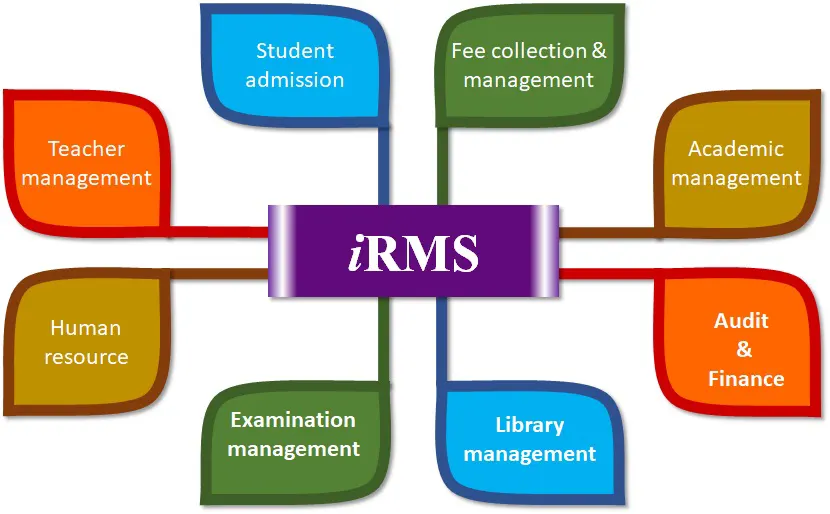
Academic management
- Programme and Course structure design as per NEP 2020.
- Course and curriculum planning.
- Class scheduling.
- Curriculum development and tracking
- Faculty assignments and workload management.
- Exam and assessment management.
Student management
- Student registration.
- Student application for a programme/course.
- Course selection and registration for students.
- Maintain detailed records of students.
- Assignments and Reading material
- Fee receipts and bonafides.
- Exam and assessment management.
Admission management
- Student Applications: Online application submission, application tracking, and fee payment.
- Admission Criteria: Set and manage admission criteria and eligibility checks.
- Enrollment: Automated student enrollment process post-admission.
- Merit lists preperation
Fee management
- Fee Structure: Define and manage fee structures for various courses and programs.
- Fee Collection: Automated fee collection and receipt generation.
- Fee Tracking: Monitor pending and collected fees.
- Reports: generation of classified fee reports.
Account and Finance
- General Ledger: Maintain financial records and accounts.
- Budgeting: Create and manage budgets for different departments.
- Payroll: Process payroll for faculty and staff, including tax calculations and deductions.
Library Management
- Catalog Management: Maintain records of books, journals, and digital resources.
- Circulation: the issue and return of library materials.
- Inventory Management: Track and manage library inventory and stock.
Examination Management
- Exam Scheduling: Automated creation of examination schedule, hall tickets.
- Evaluation and Grading: Assign evaluators, marks entry, verification and revaluation .
- Results: Compile results from various evaluators and calculate final grades for each student. Statement of marks.
Faculty Management
- Faculty Records: Maintain detailed records of faculty members, including qualifications, experience, and contact information.
- Workload Management: Track and allocate teaching and administrative responsibilities.
- Performance Evaluation: Monitor and evaluate faculty performance.
Why iRMS ERP?
By implementing a iRMS ERP system with these structured modules, colleges and universities can streamline their operations, enhance communication, improve data accuracy, and ultimately provide a better educational experience for students and faculty.
Implementing a iRMS ERP system transforms how a higher education institution operates, making processes more efficient, data-driven, and student-centered. It helps in achieving better management of resources, improved communication, enhanced student and staff experience, and robust compliance with regulations. Overall, a College ERP system is a valuable investment that can lead to significant improvements in the quality of education and administrative efficiency
Improved Efficiency and Automation
Streamlined Processes: ERP systems automate and streamline various administrative and academic processes, reducing manual work and minimizing errors.
Time Savings: Automation of repetitive tasks such as admissions, fee collection, and examination management saves significant time for staff and students.
Enhanced Data Management and Accessibility
Centralized Data: Consolidates all institutional data into a single, centralized database, ensuring consistency and easy access.
Real-time Information: Provides real-time access to data, enabling quick decision-making and response to issues.
Enhanced Student Experience
Self-service Portals: Provides students with self-service portals for accessing information, registering for courses, paying fees, and checking exam results.
Personalized Experience: Offers a more personalized experience through tailored notifications and services.
Accurate Reporting and Analytics
Custom Reports: Generates custom reports for various needs, such as academic performance, financial reports, and compliance documentation.
Data Analytics: Utilizes data analytics to identify trends, predict future outcomes, and make informed decisions.
Compliance and Security
Regulatory Compliance: Ensures compliance with educational and financial regulations through automated processes and reporting.
Data Security: Protects sensitive data with robust security measures, reducing the risk of data breaches and unauthorized access.